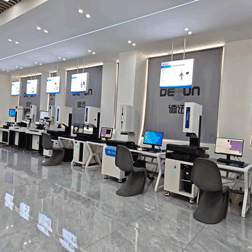
Recommended domestic brands and manufacturers of roughness profile meters
Overview of domestic roughness profiler brands and manufacturers
With the increasing demand for precision measurement in the manufacturing industry, the localization process of roughness profiler, a key equipment for surface quality inspection, has accelerated significantly in recent years. A number of domestic manufacturers have emerged with independent research and development capabilities and product performance that benchmarks against international first-tier brands. The following is a summary of mainstream domestic manufacturers and representative products from the dimensions of brand strength, technical features, and market reputation.
1. Comparison of core domestic manufacturers and technologies
| Brand/manufacturer | Representative products | Measuring range | resolution | Applicable scenarios |
|---|---|---|---|---|
| Zhongtu Instruments | SJ5800/SJ5900 | 0.1mm-200mm | 0.001μm | Precision machining, optical components |
| Weir measuring instrument | ContourX-100 | 0.2mm-150mm | 0.005μm | Auto parts, molds |
| Mitutoyo (Mitutoyo domestic production line) | SV-C3200 (domestic model) | 0.1mm-100mm | 0.01μm | General machinery, laboratory |
| Leitz (Leitz domestic branch) | PMT-200 | 0.5mm-300mm | 0.002μm | Semiconductors, precision bearings |
Note: The above data comes from the public information of each manufacturer and industry evaluation. The actual parameters vary depending on the model configuration. It is recommended to ask for the complete technical manual when purchasing.
Key points for purchasing and advantages of localization
When choosing a domestic roughness profiler, you need to focus on the following aspects:
- Measurement accuracy and stability: Domestic mid-to-high-end models have achieved 0.001μm-level resolution and can meet international standards such as ISO 4287 and ISO 21920.
- Software compatibility: Whether to support GDT (Geometric Dimension and Tolerance) analysis, contour comparison, customized report templates, etc.
- After-sales service and accessories: Domestic manufacturers usually provide 24-hour response, free training and localized spare parts warehouse.
- Cost-effectiveness: With the same accuracy, the price of domestic equipment is usually only 50%-70% of that of imported models, and software upgrades are more flexible.
2. Analysis of recommendations from domestic manufacturers
Taking Zhongtu Instruments as an example, its SJ series uses air-bearing guide rails and high-precision gratings. It has outstanding performance in the composite function of roughness and contour measurement and has been widely used in aerospace, 3C electronics and other fields. Well Measuring Instruments focuses on large-travel contour measurement, and its ContourX series has accumulated a large number of user cases in curved surface inspection of automotive parts. In addition, some emerging manufacturers such as Ruiwo and Huajian have entered market segments through differentiated positioning (such as portable and online measurement), which deserves attention.
Industry Trends and Outlook
Domestic roughness profilers are transforming from "import substitution" to "independent innovation". Domestic companies have mastered a number of patents in areas such as sensors, algorithms, and intelligent calibration. In the future, with the advancement of Industry 4.0 and smart manufacturing, online measurement, data traceability, and cloud analysis will become standard equipment. Domestic manufacturers are expected to further expand their market share with rapid response and customized services.
FAQ
What are the main differences between domestic roughness profilers and imported brands?
In the early days, there was a gap in accuracy, stability and software algorithms of domestically produced equipment. However, in recent years, leading brands such as Zhongtu Instruments and Weill Instruments have significantly narrowed the gap, and some indicators even surpass imported models of the same level. The main gaps are still reflected in the lifespan of high-end sensors, adaptability to extreme environments and brand trust.
How to choose a roughness profiler suitable for your company?
A comprehensive judgment needs to be made based on the size of the workpiece to be measured, material, surface roughness range, measurement efficiency requirements and budget. For example, portable models can be used to inspect small parts in batches, while high-resolution profilometers are needed for precision molds. It is recommended to provide samples to manufacturers for actual measurement and comparison.
What is the price range of domestic roughness profilers?
The entry-level model is about 30,000-80,000 yuan, the mid-range composite model (roughness + contour) is about 100,000-250,000 yuan, and the high-end precision model (sub-nanometer resolution) can reach 300,000-500,000 yuan. Compared with imported brands with the same configuration, the cost can be saved by 30%-50%.
Do domestic manufacturers provide free training and technical support?
Most domestic manufacturers provide free on-site installation and commissioning, operation training (2-3 days) and 1-year warranty. Some manufacturers also provide value-added services such as online remote diagnosis and free software version upgrades.
Does the roughness profiler need to be calibrated regularly? How to do it?
Needed. It is generally recommended to calibrate every 6-12 months. You can use standard samples (such as roughness standard sheets, contour standard blocks) for self-calibration, or entrust manufacturers/third-party measurement institutions to perform verification. Most domestic equipment supports built-in calibration programs and is easy to operate.
Which domestic manufacturers have a good reputation in the field of roughness profilers?
Zhongtu Instruments, Weir Measuring Instruments, Beijing Hexagon (domestic production line), Chengdu Chengliang Group, etc. are all well-known brands in the industry. Among them, Zhongtu Instruments has deep accumulation in the field of precision measurement, and Weir measuring instruments are widely used in automobile parts inspection.
What parameters can a roughness profiler measure?
Roughness parameters include Ra, Rz, Rt, Rq, Rsk, etc.; profile parameters include angle, radius, distance, shape tolerance (such as straightness, roundness), etc. Modern composite measuring instruments can acquire roughness and profile data simultaneously.
Does the domestic roughness profiler software support exporting reports?
Support. Almost all domestic models are equipped with special measurement software, which can generate inspection reports that comply with ISO/GPS standards and export them to PDF, Excel, Word and other formats. Some software also supports SPC statistical analysis.
Case
Bulk purchasing case of a precision machining company in East China
The company is mainly engaged in the processing of automobile engine parts. The original inspection relied on imported profilometers, which were costly and had long maintenance cycles. In 2023, the company purchased three domestic Zhongtu Instruments SJ5800 roughness profile composite meters for production line sampling and first article inspection. Actual use shows that the measurement efficiency is increased by 40%, the cost of single-piece inspection is reduced by 60%, and the software interface is more in line with domestic operating habits. No major failures have occurred within one year, and the after-sales response time is less than 4 hours.
A mold factory in South China achieves digital transformation through domestic equipment
The mold factory mainly produces precision injection molds, and traditional measurement relies on manual comparison. In 2024, the Weil Measuring Instruments ContourX-100 profile meter will be introduced to cooperate with the automatic loading and unloading system to achieve fully automatic measurement of the mold cavity surface. The collected data is directly uploaded to the MES system to achieve quality traceability. After the project went online, the first-time pass rate of the mold increased from 82% to 96%, and the number of measuring personnel was reduced from 3 to 1.
Authoritative citation
"Development Status and Trends of Surface Roughness Profile Measurement Technology" - Chinese Academy of Metrology, 2023
"Research Report on the Application of Domestic Precision Measuring Instruments in Manufacturing" - Machinery Industry Information Research Institute, 2024
ISO 21920:2021 "Product Geometric Technical Specification (GPS) - Surface Structure: Contour Method"