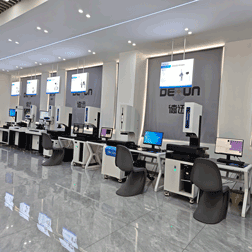
Recommended brands and manufacturers of domestic roughness meters
Domestic roughness meter market structure and leading brands
As a core testing tool in the field of precision manufacturing, the roughness meter’s measurement accuracy and stability directly affect product quality. In recent years, with the upgrading of the domestic manufacturing industry, domestic roughness meter brands have shown strong competitiveness in terms of technology iteration and cost performance. At present, mainstream brands on the market include Sanfeng (although it is Japanese but deeply cultivated in China), Huachen Terry, Shanghai Ricoh and Shenzhen Zhongtu Instruments, etc. Among them, Huachen Terry has a high market share among small and medium-sized enterprises with its self-developed sensor technology and portable design; Shanghai Ricoh relies on the accumulation of established measuring instrument manufacturers and has performed steadily in the field of desktop roughness meters.
Comparison of brand technology routes
- sensor technology: Mainstream domestic brands mostly use piezoelectric or magnetoelectric sensors with a resolution of up to 0.001μm, meeting the conventional detection requirements of Ra 0.025~16μm.
- Software Ecology: The leading brand has realized the linkage between PC data analysis software and mobile APP, supporting one-click switching of ISO, ANSI, DIN and other multinational standards.
- Durability: Industrial-grade models generally pass IP54 dustproof and waterproof certification and are suitable for oily and dusty environments in workshops.
Selection guide: How to match production needs
When purchasing a roughness meter, you need to comprehensively consider the measurement range, accuracy level, portability and after-sales service. The following are selection suggestions for common application scenarios:
| Application scenarios | Recommended parameters | Represent the brand |
|---|---|---|
| Workshop on-site inspection | Portable, battery powered, IP54 protected | Huachen Terry, Sanfeng |
| Laboratory precision analysis | Desktop, high resolution, multi-parameter output | Shanghai Ricoh, China Graphics Instruments |
| Auto parts batch quality inspection | Automation interface, data traceability function | Huachen Terry, Sanfeng |
Tips: For high-precision mold processing (Ra≤0.1μm), it is recommended to give priority to models that support stylus measurement and have temperature compensation functions.
Advantages and future trends of domestic instruments
The core advantages of domestic roughness meters are their affordable price (about 60% to 70% of imported brands) and fast response to localized services. According to industry research, the share of domestic instruments in the domestic market has exceeded 45% in 2023, an increase of nearly 20 percentage points from five years ago. In the future, as AI algorithms are integrated into measurement data processing, domestic manufacturers are evolving towards intelligence and networking. For example, cloud synchronization of measurement data is achieved through 5G modules to help companies build digital quality control systems.
FAQ
What are the main differences between domestic roughness meters and imported brands?
Domestic instruments are close to imported brands in basic measurement accuracy, but high-end models still have gaps in long-term stability, sensor life and software ecology. The price advantage is significant and suitable for small and medium-sized enterprises with limited budget.
How to choose the measuring range of roughness meter?
It needs to be determined according to the surface roughness standard of the workpiece being measured. General machined parts Ra 0.8~6.3μm are suitable for mid-range models; precision optical components Ra≤0.1μm require high-resolution desktop instruments.
Does the roughness meter need to be calibrated regularly?
Yes. It is recommended to use standard roughness samples for calibration every 6 to 12 months to ensure that the measurement data meets the requirements of international standards such as ISO 11562.
What are the advantages and disadvantages of portable and desktop roughness meters?
Portable instruments are convenient for on-site testing, but the accuracy is slightly lower; desktop instruments have high precision and full functions, but need to be used in a fixed laboratory environment.
Does the domestic roughness meter support multi-standard switching?
Mainstream brands support one-click switching of international standards such as ISO, ANSI, DIN, JIS, etc. to meet export product testing needs.
Case
Roughness inspection upgrade project of an auto parts factory
The factory originally used imported roughness meters, and the annual maintenance cost was as high as 150,000 yuan. After switching to the Huachen Terry portable roughness meter, the detection efficiency increased by 30%, the annual cost was saved about 100,000 yuan, and the after-sales service response time was shortened from 72 hours to 24 hours.
Precision testing solutions for mold manufacturing companies
A mold factory in Shanghai uses a Shanghai Ricoh desktop roughness meter, combined with AI data analysis software, to realize automatic determination and report generation of mold cavity roughness. The pass rate of products during one-time inspection has increased from 88% to 95%.
Authoritative citation
China Instrument Industry Association. (2023). Domestic precision measuring instrument market development report.
ISO 11562:1996. Geometrical product specifications (GPS) — Surface texture: Profile method — Metrological characteristics of phase-sensitive (roughness) instruments.